workshop
EuroCham :
Personal branding
for corporate leaders
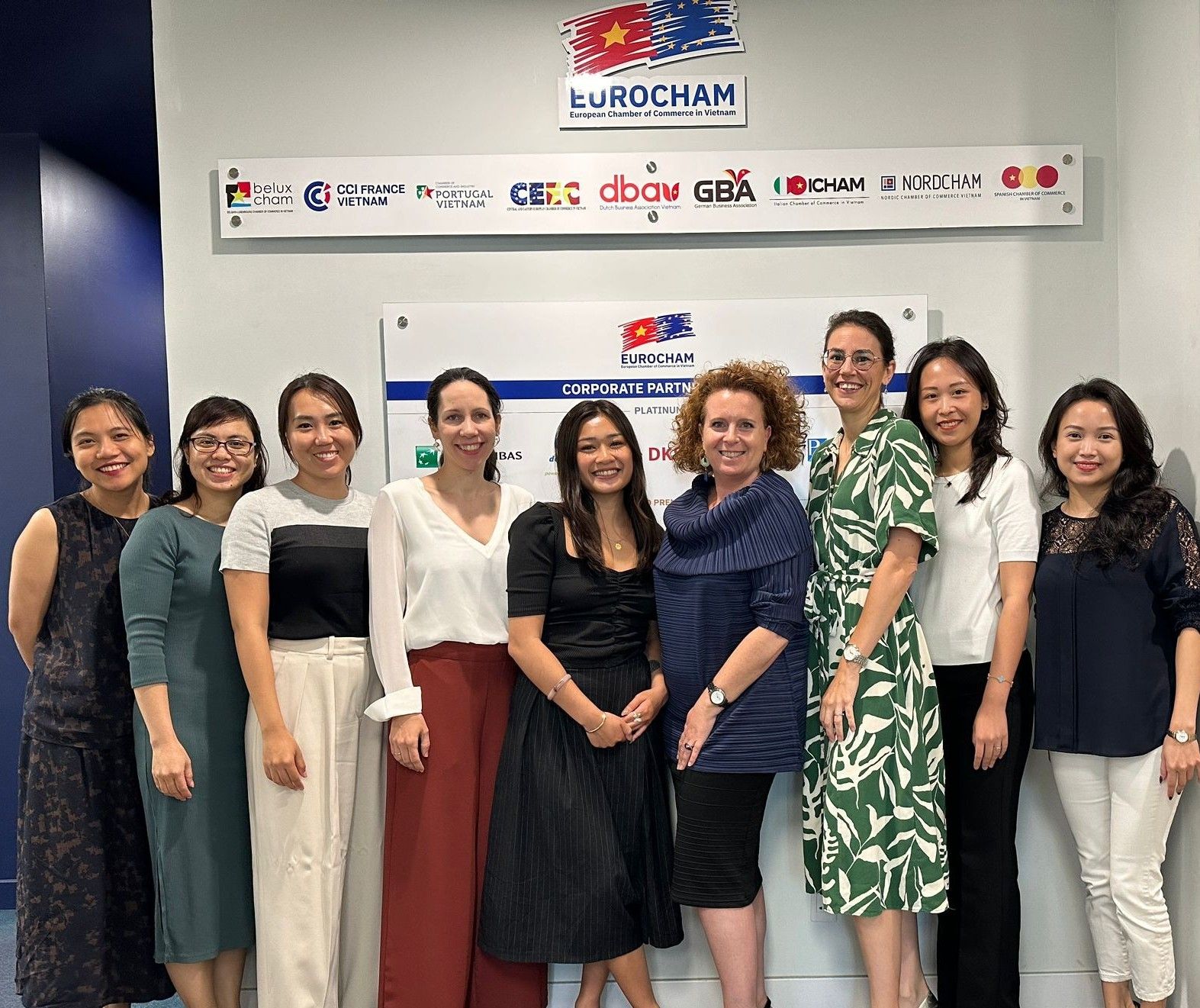
EuroCham brought us in to lead a personal branding workshop for 8 of their department heads : HR, Sales, Marketing, and beyond.
Senior profiles, busy schedules, and a common starting point: skepticism.
Client
Eurocham Vietnam
Service
Workshop
Year
2025
Location
Paris
The context
EuroCham, the European Chamber of Commerce in Vietnam, brought us in to design and lead a full personal branding program
for 8 of their department heads. HR Directors, Sales leads, Marketing managers, and senior executives across functions.
High-caliber profiles, packed schedules, and a shared starting point: skepticism.
Most had never posted on LinkedIn or social media.
Several were quietly dealing with imposter syndrome : the feeling that they didn't have anything interesting to say, or that putting themselves out there would come across as self-promotional. A few simply didn't see the point. "I'm not an influencer" was said more than once before we even started.
The challenge wasn't teaching LinkedIn mechanics. It was making these leaders want to show up online, in a way that felt authentic,
not performative. And doing it with eight very different people, across very different functions, each with their own relationship to visibility
and self-expression.
The approach
We structured the program in four phases, alternating between collective sessions, pair workshops, and individual work designed to progressively build both clarity and confidence.
Phase 1, The Reframe
We opened by dismantling the biggest myth around personal branding: that it's about ego. About being loud, visible, and constantly selling yourself. We replaced that framing with something simpler : personal branding is what people remember about you when you're not in the room.
It's your voice, your perspective, your value. And LinkedIn is simply the platform where that reputation lives online.
We walked through the data: why personal profiles consistently outperform company pages, why people buy from people, and why even one post per week, done with intention, compounds into real professional visibility over time. We also addressed the elephant in the room : imposter syndrome. We talked about it openly, normalized it, and reframed it as a signal of self-awareness rather than a reason to stay invisible.By the end of this phase, the skepticism in the room had noticeably shifted.
Phase 2, Audit & Discovery
Before building anything, we audited. Each participant went through a structured self-assessmen, mapping their career milestones, their areas of genuine expertise, the topics they could talk about for hours, and the professional opinions they'd never dared to share publicly. This wasn't
a LinkedIn exercise. It was a clarity exercise.
We then split the group into pairs for a profile analysis workshop. Each duo received a set of real LinkedIn profiles to dissect, some strong, some weak, all anonymized. Their brief: identify what works, what falls flat, and why. The discussions were immediately rich. Leaders who had never thought about LinkedIn suddenly had strong opinions about authenticity, credibility, and what makes a post worth reading.
This peer dynamic surfaced something important : leaders recognizing each other's expertise and perspective in ways they hadn't articulated before. Several participants realized for the first time that their colleagues saw them as more credible, experienced, and interesting than they saw themselves.
Phase 3, Building the Narrative
This is where the real construction happened. Each participant worked individually to define their three narrative pillars, the recurring themes that would anchor their LinkedIn presence. Not job titles. Not company achievements. Their actual point of view on their industry, their leadership philosophy, the problems they care about solving.
We pushed them to go beyond the obvious. The goal wasn't to describe what they do, it was to articulate how they think. Every pillar was then stress-tested in a live group debrief : each person shared their pillars and received direct feedback from both peers and facilitators.
The room became a sounding board, and the quality of feedback was remarkable, sharp, honest, and genuinely useful.
From there, participants drafted their LinkedIn headline — not their job title, but how they solve problems and who they solve them for.
Then the opening lines of their About section. Then their first post idea. Step by step, the abstract became concrete.
Phase 4, The Action Plan & Commitment
We closed with a no-excuses output session. Every participant left the room with a completed personal branding brief : their narrative pillars, their headline, their About section opener, and a 4-week editorial starter plan with suggested post formats tailored to their profile, their industry, and their comfort level with visibility.
Hot takes. Lessons learned. Behind-the-scenes. Point of view pieces. Career stories. We matched formats to personalities, because not every leader needs to write the same kind of content to build a powerful presence.
Each participant also made a public commitment in front of the group — one concrete action for the following week. A post. A profile update.
A comment on someone else's content. Small, but deliberate.
What we delivered
Beyond the sessions, we provided each participant with a post-workshop personal branding toolkit : a structured document summarizing their narrative pillars, their headline, their content directions, and their 4-week editorial plan.
We also delivered a LinkedIn best practices guide to EuroCham for internal use, so the momentum from the program could be maintained
and shared across the broader organization over time.
The outcome
Every participant left with a clear LinkedIn direction, a personal tagline, and a concrete plan to execute. More importantly, they left convinced that showing up online , even once a week, even with one idea was both doable and worth it.
The shift in energy from the first session to the last was palpable. People who had arrived dismissive left engaged.
Leaders who thought they had nothing to say discovered they had more perspective, experience, and story than they'd ever given themselves credit for.
Because the best personal brands aren't built by the loudest people in the room.
They're built by the clearest ones.
Format: half day workshop person program · 8 senior participants · Pair workshops, group sessions & individual exercises · Post-workshop personal branding toolkit